Giving Each Agency Client Scoped Visitor Data Access
Enforce visitor data isolation at the infrastructure level, not the dashboard.
- Written by
- Darius Yuen-Castillo
- Published
- October 15, 2026
- Reading time
- 10 min read
What this covers
- Why agencies cannot share a single visitor data environment across clients
- What domain-scoped access actually means in a visitor intelligence context
- How the partner account model structures the agency–client relationship
- Provisioning a new client: pixel deployment, API key generation, and the first data check
Giving each agency client scoped visitor data access is not a dashboard configuration problem. It is an architectural requirement that must be enforced at the pixel, the API key, and the data store. Agencies that treat visitor identification as a single shared environment will eventually push the wrong visitor into the wrong client's CRM, and no amount of filtering after the fact can repair a pipeline that was never isolated at its source.
Why agencies cannot share a single visitor data environment across clients
If you run visitor intelligence for multiple clients, you have a structural problem that dashboard filtering cannot solve. When a single pixel fires across multiple client domains and feeds one webhook stream or one API key, identifications from different clients land in the same queue. Enrichment records mix. CRM syncs push the wrong visitors into the wrong accounts. The failure is not hypothetical, and it does not announce itself. It compounds quietly until a client asks why a competitor's prospect appeared in their pipeline.
Compliance sharpens the stakes considerably. Visitor identity records carry names, emails, job titles, and behavioral histories. That is personal data under GDPR and CCPA, and a client in a regulated industry has no tolerance for their visitors' data commingling with another client's environment, even accidentally. The operational cost also compounds over time. As the agency adds clients, a shared environment requires more manual sorting, more reconciliation, and more opportunity for human error. Those costs grow linearly with the client roster if the architecture does not enforce isolation by design.
What domain-scoped access actually means in a visitor intelligence context
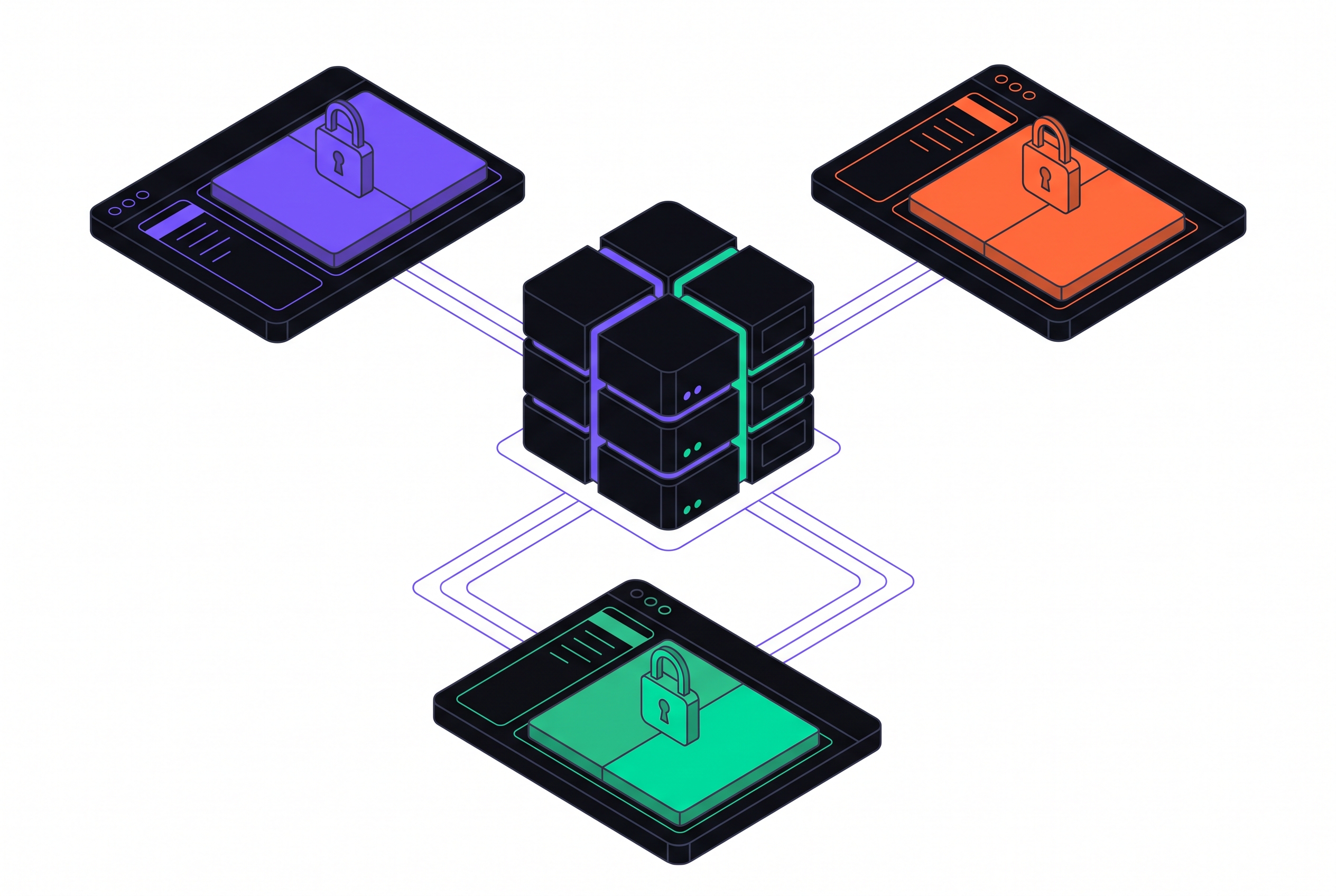
Domain-scoped access means the tracking pixel, the API key, the webhook stream, and the data store are all bound to a single client domain. Isolation is enforced at the infrastructure level, not managed by a human operator after the fact. When the scope lives in the credential and the partition rather than in a dashboard setting, there is no workflow that can accidentally cross the boundary.
The unit of isolation is the tracked domain, not the client account. One client with two websites is two domains, each with its own scope, not one client record with two data feeds merged together. Three layers must all be scoped for isolation to hold. The pixel fires only on the client's domain and sends events tagged to that domain's identifier. The API key carries domain-level permissions so a call made with Client A's key cannot retrieve Client B's visitor records, even if both sit under the same agency parent account. The data store partitions visitor records, event journeys, and enrichment results by domain so no query can return cross-client results. Leadpipe's developer guide frames pixel management, the ability to create, update, and list tracking pixels programmatically, as essential for multi-tenant platforms that need per-client isolation. It identifies this capability as one of the things that separates a production-grade API from a bolted-on afterthought.
How the partner account model structures the agency–client relationship
A partner account model places the agency at a parent level with visibility and administrative rights across all client workspaces. Each client workspace remains domain-scoped and inaccessible to other clients within the same agency. The hierarchy solves the agency's operational problem without breaking isolation: the agency can onboard a new client, provision a pixel and API key, and monitor data health across accounts, all from one administrative view, while each client's data stays siloed.
The practical consequence is that adding a client becomes a provisioning action. The agency creates the domain workspace, generates the scoped key, and deploys the pixel. Nothing about that sequence disturbs existing clients, because there is no shared configuration to change. The alternative is a flat multi-user account where client separation is enforced only by user permissions and dashboard filters. That model breaks whenever a workflow, webhook, or API call bypasses the UI layer, and those bypasses happen constantly in any environment where automation does real work.
Provisioning a new client: pixel deployment, API key generation, and the first data check
Provisioning a client in a domain-scoped architecture is a three-step sequence: create the domain workspace, generate the scoped API key, deploy the pixel. Each step must be completed before any visitor data is valid. Out-of-order setup produces unscoped or unattributed events, and those events are worse than no events because they look normal while being wrong.
The pixel is a JavaScript snippet placed in the head of the client's site. It fires on every page load and sends events tagged to the domain identifier created in step one. A pixel deployed before the domain workspace exists has nowhere to route its events. A pixel shared across client domains defeats isolation at the source. Programmatic pixel creation, generating a new pixel via API call rather than through a dashboard UI, is the capability that lets agencies scale onboarding without manual steps per client. Leadpipe's developer guide identifies this as one of the litmus-test capabilities of a production-grade visitor identification API.
The domain-scoped API key is the authentication token that enforces data isolation at the query layer. A request made with Client A's key returns only Client A's visitor records. Keys should be generated per domain, not per agency user, so the scope travels with the credential rather than depending on which user is authenticated. Before handing a client workspace to a client-facing workflow, the agency should verify three things: inbound events carry the correct domain tag, a test identification returns only records from that domain, and the webhook endpoint receives events only for that domain's visitors. This check catches misrouted pixels and key-scope misconfigurations before they produce contaminated data the agency has to explain to a client.
What a per-client visitor record contains and why the data structure matters for downstream workflows
A visitor identification that returns only a company name is not a lead. It is a prompt to go find a lead. Person-level records that carry name, title, company, LinkedIn, a business email, a phone number, seniority, job function, and a full event journey are what make automated downstream workflows possible without a manual research step in between. The record's completeness at the moment of delivery determines whether the identification produces pipeline or homework.
The event journey is what separates a notification from a lead. Knowing that a VP of Engineering spent an extended period on the pricing page, scrolled to the bottom, and arrived via a LinkedIn ad gives the sales rep or the automated workflow context that a single identification ping cannot carry. Ad source attribution at the person level closes the loop on paid media spend. When the identified visitor's record includes which ad platform and campaign brought them, the agency can report to the client not just who visited but which budget line produced that visit. Company-level identification cannot provide this because the IP match does not carry UTM or ad-platform attribution at the individual level.
Routing identified visitors into per-client pipelines: webhooks, CRM sync, and Slack alerts
A scoped visitor record that stays in a dashboard is not a pipeline asset. It only becomes one when it routes automatically into the CRM, the sales team's Slack channel, or an outbound sequence, all scoped to that client's accounts and team members. The domain-scoped API key governs which webhook stream each endpoint receives. Client A's endpoint gets only Client A's person.identified events. Leadpipe's developer guide distinguishes two webhook trigger modes. First match fires once when a visitor is identified for the first time, which suits lead capture and CRM record creation. Every update fires on each new behavioral event, which suits engagement scoring and return-visit alerts. The guide recommends webhooks for real-time use cases alongside the REST API for historical queries and backfills.
CRM integrations should map identified visitor records to existing accounts, log visit activity against the relevant record, and trigger tasks or sequences for the assigned account owner. They should not just create a new contact record and stop. The CRM status field in the visitor record, in CRM, not in CRM, or customer, lets the sync logic branch: new contacts get created, known contacts get activity logged, existing customers get routed away from sales sequences. The most common post-integration failure is not the initial connection but ongoing data quality. Duplicate records, missing field mappings, and sync conflicts emerge weeks after go-live, and the more customization a client's CRM has accumulated, the more mapping work the agency must do upfront.
The alert format determines whether a sales rep can act immediately or must go research first. A LinkedIn profile pinged into a Slack channel is a notification. A person-level record with email, phone, pages viewed, and ad source is a lead. Per-client Slack channels, fed by domain-scoped webhook streams, ensure that Client A's sales team sees only Client A's visitor alerts, not a shared agency-wide feed that requires the rep to filter by client before acting.
AI agent and bot traffic: why it must be separated before match rates mean anything
A visitor identification match rate that does not separate AI agents and bots from human sessions overstates what a tool actually identifies. When an agency reports match rates or pipeline figures to a client, inflated denominators produce inflated claims. AI crawlers are a live and growing source of contamination. GPTBot, ClaudeBot, PerplexityBot, and other AI training and retrieval agents request pages, consume content, and appear in server logs, but they do not execute JavaScript and are largely invisible to standard client-side analytics like GA4. They are not buyers, and attempting to identify them as persons produces junk records.
Detection is not straightforward. Many AI agents do not self-identify reliably, and some use residential IP rotation and spoofed user agents that are indistinguishable from human visitors at the browser layer. Server-side detection and behavioral fingerprinting are necessary alongside user-agent pattern matching. There is a secondary value in doing this properly. Knowing which AI agents are visiting a client's site, which pages they consume, and who operates them is itself intelligence. It tells the client whose AI systems are researching their products, which is commercially relevant as agentic purchasing research becomes more common.
Paid media attribution at the person level: closing the loop for agency clients
Company-level identification tells an agency which organization visited after a paid campaign. Person-level identification with ad-source attribution tells the agency which individual from that organization visited, which ad platform brought them, and what they did on the site. The difference between those two is the difference between a traffic report and a pipeline report.
For agencies managing paid media on behalf of clients, this closes the attribution loop that dashboard-level ad platform reporting cannot close. Ad platforms report clicks and conversions. Person-level visitor intelligence reports who the clicks were, what they looked at, and whether they match the client's ICP. The agency can demonstrate that the budget produced real buyers in the pipeline, not just impressions and click-through rates. That is a materially different deliverable, and it changes the conversation from media efficiency to revenue contribution.
Scaling the agency client roster without rebuilding the architecture
The test of a domain-scoped architecture is whether adding the tenth client takes the same effort as adding the second. If provisioning is programmatic, the answer is yes. If it requires manual dashboard configuration for each client, complexity compounds with every addition. Programmatic provisioning via API, creating a domain workspace, generating a scoped API key, and registering a pixel without touching a UI, is what makes the architecture scale. The agency writes a provisioning script once and runs it for every new client, with no per-client manual steps.
Leadpipe's developer guide identifies the ability to programmatically create a pixel for a new client, receive identified visitors via webhook, query historical data, and monitor credit balance, all without touching a dashboard, as the litmus test for a real API versus a feature gap that will block the agency later. The MCP connector is a forward-looking capability in this direction. As agentic AI tools become part of agency workflows, summarizing visitor activity, drafting outreach, or flagging ICP matches, the connector lets those AI agents query per-client visitor data directly through the API using per-pixel domain filtering. The agency does not build a custom integration layer for each new agentic tool it adopts. The architecture is already shaped for where agency tooling is heading.
What to check before committing to a visitor intelligence platform for agency use
The architectural principles this piece describes translate directly into vendor evaluation criteria. A platform that cannot enforce isolation at the API key and data store level cannot deliver the architecture, regardless of what its dashboard filters show. Five questions can structure any vendor evaluation.
Does the platform support domain-scoped API keys, one key per client domain with no cross-domain data access, or does one key grant access to all client data under an agency account? Can pixels be created and managed programmatically via API, or does each new client require manual dashboard setup? Do webhooks deliver events scoped to a single domain, or does the agency receive a combined event stream it must filter? Does the platform separate AI agent and bot traffic from human sessions before reporting identification rates, and does it report what the AI agents are doing as a separate signal? Does the person record carry ad-source attribution, which platform and campaign brought the visitor, alongside identity enrichment, or is attribution a separate product or integration?
Record completeness is the practical test beneath all five questions. A name and company without an email, phone, or event journey requires the sales rep to do enrichment research before acting. That identification did not produce a lead. It produced a starting point. The question to ask is what the record contains at the moment of delivery, not what the platform can theoretically return.